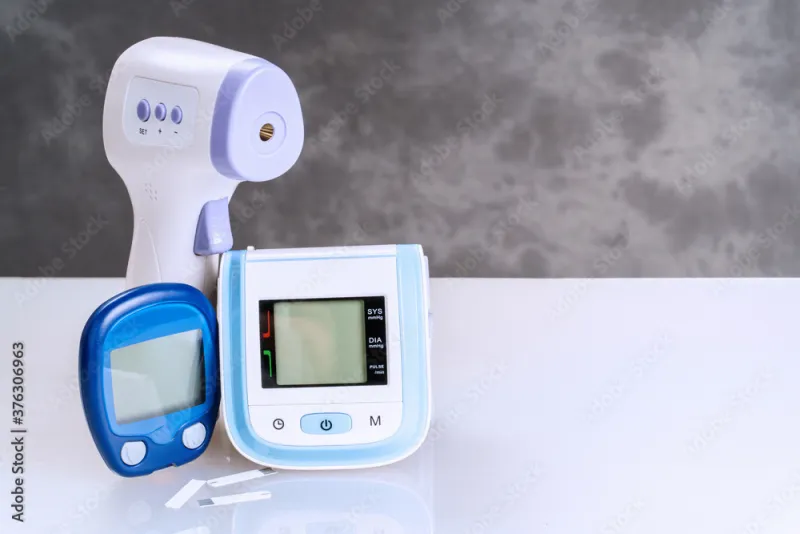
Devices Don't Heal People—Doctors Do: Bridging the Gap Between Home Health Data and Clinical Action
Photo: Mennonite Church USA Archives, No restrictions, via Wikimedia Commons
America has embraced the quantified self with remarkable enthusiasm. Pulse oximeters sit on nightstands. Continuous glucose monitors are strapped to forearms at the gym. FDA-cleared blood pressure cuffs sync automatically to smartphone apps, logging months of cardiovascular data with clinical-grade precision. By nearly every measure, the consumer health technology market is thriving—and yet a troubling paradox has emerged alongside it.
The data exists. The infrastructure to act on it, for many Americans, does not.
A Flood of Numbers Without a Riverbank
Consider what happens after a home blood pressure monitor flags three consecutive readings above 140/90 mmHg. The device has done its job. The alert appears. The user, now understandably anxious, attempts to schedule an appointment with their primary care physician—only to encounter a six-week wait, an overloaded nurse line, or a patient portal that offers no mechanism for submitting device-generated data. The clinical moment, which should follow naturally from the monitoring moment, simply evaporates.
This is what health policy researchers have begun calling the "last-mile problem" of consumer health technology. The hardware has outpaced the healthcare system's capacity to receive and respond to the data it produces. A 2023 report from the American Medical Association noted that while remote patient monitoring adoption has grown substantially among large health systems, independent and rural providers have integrated these tools at a fraction of the rate—leaving a significant portion of the population with devices that generate signals no clinician is formally listening to.
For HealthServer Online customers who invest in home health monitoring equipment, understanding this gap is not a reason to abandon the technology. It is a reason to invest in it more strategically.
The Telehealth Ecosystem: Not All Platforms Are Equal
Not every telehealth provider is equipped to receive, interpret, and act on patient-generated health data. This distinction matters enormously when selecting both a monitoring device and a care provider.
The most clinically integrated telehealth platforms—including those affiliated with large health systems such as Kaiser Permanente, Cleveland Clinic, and major academic medical centers—have built proprietary data pipelines that allow connected devices to push readings directly into the patient's electronic health record. When a cardiologist can view six months of ambulatory blood pressure data before a fifteen-minute video visit, the quality of that consultation improves dramatically.
Standalone telehealth services, while convenient, vary considerably in their willingness and technical capacity to engage with external device data. Some operate as episodic urgent-care alternatives—useful for minor ailments, but poorly suited for chronic disease monitoring. Others have developed structured remote patient monitoring programs, particularly for conditions such as hypertension, diabetes, and heart failure, where longitudinal data is clinically essential.
Before purchasing a home monitoring device, consumers are well-served by asking a direct question: does my current provider—or the telehealth service I intend to use—have a formal mechanism for receiving and reviewing this data?
Devices That Work Within Established Clinical Ecosystems
Certain product categories are better positioned than others to function within integrated care environments.
Connected blood pressure monitors from manufacturers such as Withings and Omron have developed partnerships with major electronic health record systems, enabling readings to flow into platforms like Epic and Cerner with minimal friction. For patients managing hypertension, this connectivity is not a convenience feature—it is a clinical necessity.
Continuous glucose monitors (CGMs), once restricted to patients with diagnosed diabetes, are increasingly available to metabolically conscious consumers seeking early warning of insulin resistance. Devices compatible with Apple Health, Google Fit, and dedicated CGM apps can generate reports that endocrinologists and internists can review asynchronously—provided those clinicians have opted into data-sharing workflows.
Pulse oximeters and ECG-capable wearables occupy a more nuanced space. Consumer-grade pulse oximeters are appropriate for trend monitoring but should not replace medical-grade devices in high-acuity situations. Single-lead ECG wearables, such as those embedded in certain smartwatches, have received FDA clearance for atrial fibrillation detection—a meaningful clinical application, provided the user has a cardiologist or primary care provider prepared to review flagged events.
When shopping for home health devices, prioritize products that explicitly list EHR compatibility, support HL7 FHIR data standards, or have documented integration with major telehealth platforms. These technical specifications, while unglamorous, are what separate a health gadget from a genuine clinical tool.
Building Your Personal Health Infrastructure
The solution to the telehealth gap is not passive. It requires consumers to take deliberate steps to connect the data they generate with the professionals capable of acting on it.
Step one is provider alignment. Before purchasing any monitoring device, contact your primary care provider's office and ask specifically whether they participate in a remote patient monitoring program, and which devices or platforms they support. If your current provider has no answer to that question, it may be worth evaluating whether a different practice or health system is a better fit for your preventative health goals.
Step two is platform consolidation. Scattering health data across five separate apps reduces its clinical utility. Consolidating readings into a single platform—Apple Health, Google Health Connect, or a health system's native patient portal—creates a coherent longitudinal record that clinicians can actually review.
Step three is proactive communication. Even the most connected telehealth platform cannot replace the patient who advocates for themselves. Sharing device summaries at appointments, flagging concerning trend data through secure messaging, and asking explicitly how your provider prefers to receive monitoring information are behaviors that meaningfully improve care quality.
The Investment That Completes the Loop
At HealthServer Online, the position is straightforward: home health monitoring devices represent one of the most valuable preventative health investments available to American consumers. A blood pressure cuff that catches a hypertensive trend before it becomes a cardiac event, a CGM that reveals postprandial glucose spikes before a diabetes diagnosis—these are not hypothetical benefits. They are documented, clinically supported outcomes.
But the device is only half the investment. The other half is building the clinical relationship and the technical infrastructure that allows the data to matter. A reading that reaches your physician changes your care. A reading that sits in an app no one reviews changes nothing.
The gap between those two outcomes is closeable. It simply requires intention.